


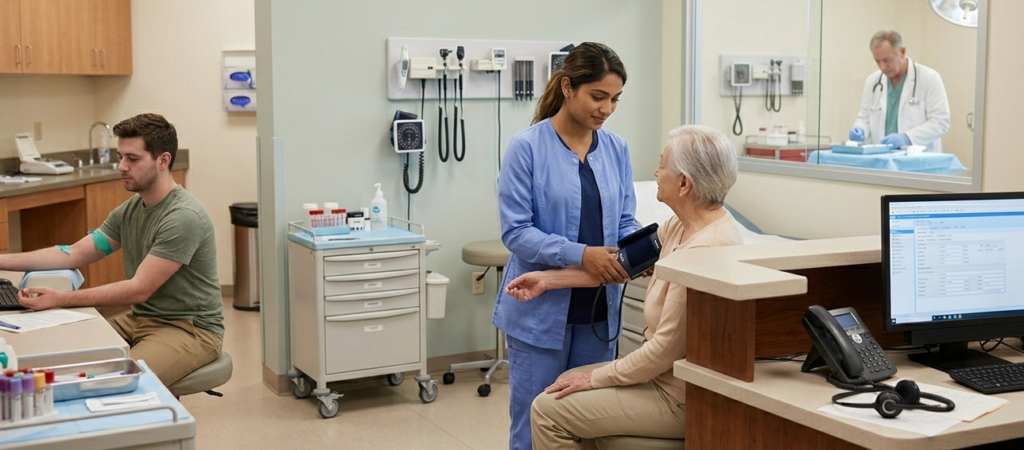
Learn how medical assistant duties can include both clinical and administrative responsibilities in healthcare settings.
Medical assistants may perform a combination of clinical and administrative tasks, making versatility an important part of the occupation. Their responsibilities can vary by healthcare setting, specialty, employer, and state requirements.
At Stautzenberger College, the Medical Assistant Diploma combines clinical and administrative training in a hybrid format. The program is designed to help students develop skills used in physicians’ offices, hospitals, outpatient care centers, clinics, and other healthcare environments.
Why Medical Assistant Duties Can Vary
Medical assistants complete clinical and administrative tasks that support healthcare practices. Some focus primarily on clinical or administrative responsibilities, while others perform a combination of both.
Depending on the healthcare setting and applicable state requirements, medical assistants may take vital signs, record medical histories, help physicians with examinations, schedule appointments, enter patient information into medical records, and perform other clinical or administrative tasks.

The range of potential responsibilities means medical assistants may use different skills throughout the workday depending on their role and healthcare setting.
Clinical and Administrative Medical Assistant Duties
Medical assistant duties vary by state, employer, specialty, and healthcare setting. Common responsibilities may include:
- Taking and recording vital signs and medical histories.
- Helping physicians with patient examinations.
- Scheduling appointments and updating patient records.
- Collecting and preparing specimens for laboratory testing, when permitted.
These responsibilities illustrate how medical assisting can combine patient-facing tasks with administrative work. The specific combination depends on the position and healthcare setting.
Education and Training for Medical Assistants
Medical assistant education may be offered through diploma, certificate, or degree programs. At Stautzenberger College, Medical Assistant is offered as a Diploma program.
Skills Students May Develop in Medical Assistant Training
Medical assistant training may cover both patient-care procedures and administrative responsibilities used in healthcare settings.
Coursework may include areas such as:
- Basic clinical procedures and patient-care techniques.
- Medical terminology and documentation.
- Healthcare documentation and administrative procedures.
- Professional communication and ethics.
These areas can help students become familiar with both the clinical and administrative responsibilities they may encounter in medical assisting roles.
Medical Assistant Career Outlook
The U.S. Bureau of Labor Statistics projects employment of medical assistants to grow 13% from 2025 to 2035, compared with about 3% for all occupations. Approximately 109,700 openings per year are projected on average over the decade.
The BLS reported a national median annual wage of $45,690 in May 2025 for medical assistants.
Employment projections describe the occupation overall and do not guarantee employment for individual graduates. Employment and salary outcomes vary by location, experience, employer, credentials, and individual circumstances.
Medical Assistant Training at Stautzenberger College
Stautzenberger College’s Medical Assistant Diploma is designed to be completed in 10 months and requires 60 quarter credits. The hybrid program combines on-campus and online learning while covering clinical and administrative skills associated with medical assisting.
The combination of clinical and administrative education gives students opportunities to develop skills associated with different aspects of medical assisting before pursuing entry-level employment.
Learn More About Medical Assisting
Interested in learning more about medical assisting? Explore Stautzenberger College’s Medical Assistant Diploma to review the curriculum, program format, and admissions information and determine whether the program aligns with your educational goals.