


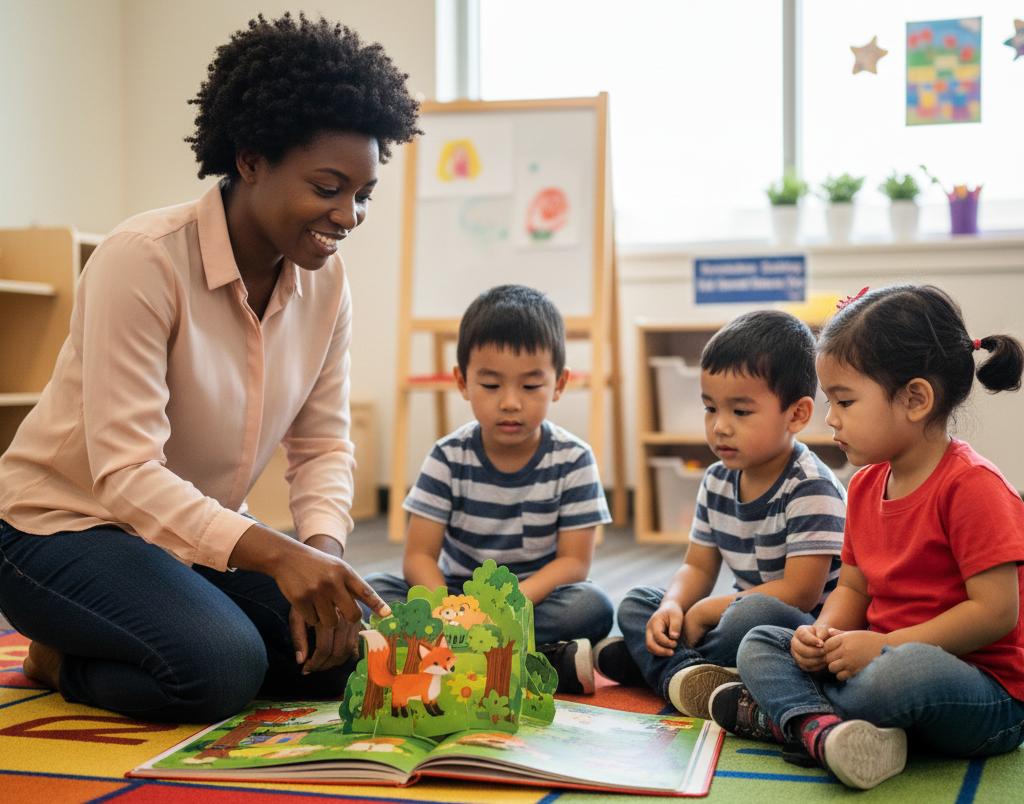

When we look at the trajectory of a successful adult life—marked by emotional resilience, academic achievement, and social stability—the starting point is almost always the same: a high-quality early childhood experience.
The first five years of life are a period of unparalleled transformation, where the brain develops at a faster rate than at any other time. During these formative years, the presence of a skilled educator is not just beneficial; it is foundational.
At Stautzenberger College, we are dedicated to preparing the next generation of “architects of the brain” through our Early Childhood Education program.
Our 7-month online diploma is designed to equip you with the theoretical knowledge and hands-on clinical skills needed to support children of all abilities. Whether you are studying at our Maumee or Brecksville campuses, you will learn to implement curricula that foster healthy social, emotional, and cognitive growth. We believe that by empowering educators, we are directly investing in the future of our communities.
1. The Science of the Developing Brain

To understand why early childhood education is so critical, we must look at the biology. Research in 2026 confirms that nearly 90% of brain development occurs before a child even enters kindergarten. This period is defined by “synaptic pruning” and the rapid formation of neural pathways that govern everything from language acquisition to impulse control.
An early childhood educator acts as a guide during this high-stakes window. They provide the “serve-and-return” interactions—meaningful back-and-forth communication—that literally build the architecture of the brain. Without intentional stimulation from a trained professional, children may miss out on developing the “executive functions” (like memory and mental flexibility) that are essential for future learning.
2. Emotional Regulation: Beyond “Using Your Words”
One of the most vital roles an educator plays is helping children navigate “big emotions.” In a classroom setting, an educator provides a safe “secure base.” When a child experiences frustration or disappointment, the educator doesn’t just manage the behavior; they coach the emotion.
-
- Identifying Feelings: Educators give children the vocabulary to identify stress, joy, or anger.
-
- Self-Regulation: By modeling calm responses and teaching coping strategies (like deep breathing or quiet-time zones), educators help children move from the “amygdala-driven” reactive state to a “prefrontal-cortex” thinking state.
- Co-Regulation: The educator’s own calm presence helps stabilize a child’s nervous system, a skill that eventually leads to the child’s ability to soothe themselves.
3. The Social Laboratory: Learning to Live Together
For many children, an early childhood education center is their first experience in a society outside their family. This “social laboratory” is where they learn the nuances of human interaction under the watchful eye of a mentor.
| Skill | How Educators Facilitate It |
| Conflict Resolution | Guiding peers through negotiations over shared toys or space. |
| Empathy | Helping a child recognize and care about the feelings of a crying classmate. |
| Collaboration | Designing group play-based activities that require teamwork to reach a goal. |
These aren’t just “soft skills.” In the 2026 workforce, the ability to collaborate and empathize is considered a primary indicator of professional success. By teaching these skills at age three, educators are prepping children for a lifetime of healthy relationships.
4. Early Detection and Intervention
Early childhood educators are often the first line of defense against developmental delays. Because they observe dozens of children across various milestones, they are uniquely positioned to notice when a child isn’t meeting a benchmark in speech, motor skills, or social engagement.
In our program at Stautzenberger College, we emphasize the importance of keeping detailed records and recognizing the signs of developmental delays. Early intervention—getting a child support at age three rather than age seven—can be the difference between a child struggling in the back of the class and one who thrives at the front.
5. The Economic and Societal Ripple Effect
The impact of a great teacher extends far beyond the individual child. Economists have noted that for every $1 invested in high-quality early childhood education, there is a return of up to 13% through improved health outcomes, higher future earnings, and lower crime rates.
By providing a stable, educational environment for children, educators also allow parents to participate more fully in the workforce, boosting the local economy and creating more resilient family units.
The Stautzenberger Advantage
Our curriculum at Stautzenberger College isn’t just about “babysitting.” It is a rigorous blend of:
-
- Child Growth & Development: Understanding the theories of Piaget, Vygotsky, and others in a modern context.
-
- Health, Safety, and Nutrition: Ensuring the physical well-being of every student.
- Emerging Curriculum: Learning how to design play-based lessons that spark curiosity and a lifelong love of learning.
Become an Early Childhood Educator
In conclusion, the role of an early childhood educator is one of the most significant and transformative professions in our society. These dedicated individuals do more than teach letters and numbers; they build the social, emotional, and cognitive foundations upon which all future learning is constructed.
At Stautzenberger College, our Early Childhood Education program is designed to transform your passion for helping children into a professional career that truly changes lives.
By mastering the science of development and the art of compassionate teaching, you become a vital partner to families and a champion for every child’s potential. The impact you make in those first five years will resonate for decades to come, shaping the leaders, thinkers, and citizens of tomorrow.
FAQs
Q1. Is a career in early childhood education strictly about teaching in a preschool?
A: Not at all. While many graduates work in preschools, others go on to become childcare center directors, family support specialists, or educational consultants. Some even work in specialized roles within social service agencies or pediatric healthcare settings.
Q2. Why is “play-based learning” emphasized so much in 2026?
A: Science shows that play is the “work” of childhood. Through play, children experiment with physics (blocks), social hierarchies (house), and language (storytelling). A trained educator uses play as a tool to hit specific developmental milestones in a way that feels natural and engaging for the child.
Q3. How does Stautzenberger College help me find a job after graduation?
A: Our Career Services team works with you from day one. We help with resume building, interview prep, and connecting you with our network of local employers who are looking for high-quality, trained educators to join their teams.